
“It’s a kind of folk music, albeit one that celebrates an idealised imaginary England where, each year, the first trills of Mike Ratledge’s Lowrey organ signal the coming of the spring. And there’s a palpable sense of ritual too. Just as Taj Mahal Travellers seemed to explore ancient, rainy mountainside temples in Japan, Fjall strike out intrepidly with a thermos and some cheese sandwiches to find the magic in the hills and valleys.” – Daniel Spicer, THE WIRE
“In an era increasingly dominated by immediacy and instant gratification, Helt stands as a reminder of the power of deep listening. It is an album that invites exploration rather than consumption, rewarding those willing to lose themselves within its vast and mysterious world. Fjall have created more than a live document, they have crafted an experience, one that transforms sound into landscape, imagination into reality, and listening into a journey that lingers long after the final note has faded.” – Zachary Nathanson, ECHOES AND DUST
“This music seems to demand an approach that is remarkably free of ego from the performers, something that can be hard to achieve I think. The individual parts here are lovely, but the whole is really wonderful. This work is mysterious , hypnotic and beautiful.” – BANDCAMP UK JAZZ & IMPROVISED MUSIC
“A remarkable album.” – Kevin Whitlock, UK JAZZ NEWS
“Fjall seem to be searching for some new expression interlacing the ancient with the modern to create a timeless, limitless soundscape appealing to all; and with these dramatic and far reaching pieces they have done just that.” – Mr Olivetti, FREQ
“A creaking, percussive, electroacoustic, ballad-like crystal world and an uncanny yet auspicious stalker zone. Blown and polypercussive shamanic magic versus crows, versus the ocean.” – Rigobert Dittmann, BAD ALCHEMY
“Fjall have evolved an eclectic way of making music which contains points of reference which could draw in listeners from more mainstream genres and open people’s ears to the wider possibilities of music ….. interesting improvised music which stretches one’s expectations of what improvised music can be.” – Dominic Rivron, INTERNATIONAL TIMES
“The album’s two-and-a-half-hour runtime is distinguished by an impressive richness of sound; nothing is ever repeated, the group never falls into predictable sonic patterns, and a vast array of instruments and sound sources is employed. It is a record that invites active listening yet also allows one to simply drift along without ever succumbing to boredom.” – Achim Breiling, BABYBLAUE SEITEN
Martin Archer – Bb and bass clarinets, sopranino saxophone, flute, bagpipe chanter, recorders, organ, melodica, harmonicas, iPad, glockenspiel, tuning forks, small percussion, loops and delays
Jan Todd – electric Harp-E, cross strung harp, bowed psaltery, tagelharpa, hulusi flutes, waterphones, Idiopan, voice, electronics, electronic samples, found sounds, looping, field recordings
Fran Comyn – snare and floor toms, cymbals frame drums, tam tam and small gongs, tabla, doumbek, bells, orchestral chimes, stir drum and shakers
Richard Jackson – four piece kit, rototoms, cymbals, slot drum, small percussion
Formed in 2022, Fjall features a cornucopia of instrumental sounds, both acoustic and electronic, which the group uses to create soundscapes rooted in folk and ceremonial music, together with field recording material drawn from the sounds of the natural world – all mixed together on a canvas of open ended improvisation.
This release documents in full two performances by the group, both in front of large and attentive audiences.
With Fjall, Archer plays reeds, small percussion and sundry electronics, joined by percussionists Fran Comyn and Richard Jackson, plus harpist, multi-instrumentalist and electronicist Jan Todd. While Fjall’s 2023 debut From The Rough Hill was a patchwork of studio and live snippets, Helt presents four lengthy improvisations between 35 and 43 minutes long, recorded at two live shows in Sheffield. As track titles “Stone”, “Edge”, “Wood” and “Dale” suggest, these expansive soundscapes seem to spring from some mythic northern English countryside. Field recordings of rain, running water and birdsong are folded into dense thickets of scurrying drums and tuned percussion, foggy drones, suddenly erupting baroque organ fantasies and clearings of acid-pastoral reverie, all unfolding with a gentle, unforced logic and calm momentum.
It’s a kind of folk music, albeit one that celebrates an idealised imaginary England where, each year, the first trills of Mike Ratledge’s Lowrey organ signal the coming of the spring. And there’s a palpable sense of ritual too. Just as Taj Mahal Travellers seemed to explore ancient, rainy mountainside temples in Japan, Fjall strike out intrepidly with a thermos and some cheese sandwiches to find the magic in the hills and valleys. – Daniel Spicer, THE WIRE
Here’s a new release from Fjall, a four piece band featuring Martin Archer, Jan Todd,Francis Comyn and @Richard Jackson. Between them they play an amazing range of instruments, and on this live album they construct a cathedral of sound for the listener to explore ( or maybe a huge cave system !) – vast hypnotic sonic spaces mesmerise and draw you in , and then your ears stumble upon highly detailed and fascinating filigree. The richness of the ever slowly shifting textures here is really something. This music seems to demand an approach that is remarkably free of ego from the performers, something that can be hard to achieve I think. The individual parts here are lovely, but the whole is really wonderful. This work is mysterious , hypnotic and beautiful. – Martin Pyne, BANDCAMP UK JAZZ & IMPROVISED MUSIC
Fjall, take two! Released in late May 2026—naturally on the Discus Music label—*Helt* is a double CD featuring two concert recordings captured at performances in Sheffield: one at the Samuel Worth Chapel and the other at a venue called Sidney & Matilda, both in December 2023. The sound quality is impeccable, and the audience—clearly spellbound—never intrudes; their presence is only truly audible at the end of each CD, when enthusiastic applause breaks out.
*Helt* comprises four expansive live improvisations, performed with virtuosity and fine interplay by Jan Todd, Martin Archer, Fran Comyn, and Richard Jackson—a group that has been performing under the name Fjall since 2022. Dense instrumental soundscapes drift along, shifting from subtle, floating textures to powerful, rumbling swells, and from delicate, dancing figures to voluminous, reverberating tones. The music is defined by percussion, Todd’s harp, and Archer’s versatile wind instruments, all underpinned by electronic sounds, resonant keyboard tones, shimmering and clattering accents, and various tape loops and field recordings—capturing environmental and natural sounds, particularly (though not exclusively) in the track “Wood.”
Overall, the music is restrained and contemplative, with sounds ebbing and flowing—at times almost fragile and gentle—yet consistently creating an atmosphere that is intense, dense, and hypnotic. While things rarely become truly abrasive or loud, there are certainly moments of robust resonance, subdued droning, or tumultuous outbursts. Nevertheless, the listening experience evokes a folk-infused, pagan-style ritual, or perhaps mysterious events manifesting as sound within remote English woods, valleys, and mountains—or even in more distant lands. At times, tracks like “Edge” and “Dale” evoke an Eastern atmosphere, conjured by the tabla and sitar-like tones. The deep, resonant, horn-like sounds—reminiscent of the *dungchen*—that emerge shortly thereafter in “Edge” lend the music a distinctly Tibetan feel. These elements are complemented by occasional wordless, ethereal, shamanistic vocal passages from Jan Todd.
The album’s two-and-a-half-hour runtime is distinguished by an impressive richness of sound; nothing is ever repeated, the group never falls into predictable sonic patterns, and a vast array of instruments and sound sources is employed. It is a record that invites active listening yet also allows one to simply drift along without ever succumbing to boredom. There is a palpable experimental “Krautrock” spirit here, alongside the dynamics of Japanese Fluxus improvisations and the raga-rock style of the Third Ear Band. Of course, Fjall ultimately carve out their own unique path, yet a certain kinship with those influences is undeniable. Anyone who appreciates that kind of music should find “Helt” right up their alley—or perhaps even be thrilled by it. – Achim Breiling, BABYBLAUE SEITEN https://www.babyblaue-seiten.de/album_23103.html#oben
Martin Archer is a busy man. Not only does he run the enterprising (and extremely prolific) British indie label which he founded in 1994, Discus Music, he’s also a reed player of some note, a producer and a master of a multitude of strange instruments. Many of them feature on the album Helt, by Fjall. Archer describes this album, a recording of two “complete” concerts, as “the group’s final statement”.
Formed in 2022, Fjall – led by Archer and fellow multi-instrumentalist Jan Todd – features an abundance of instrumental sounds. The pair are joined here by two drummer/percussionists Richard Jackson and Fran Comyn. In old Norse, Fjall means “the rough hill”. This release documents two live performances by the group, one on 27 April 2025 at Sidney & Matilda in Sheffield, and the other on 7 December 2023 at Samuel Worth Chapel, also in Sheffield.
The sleeve notes describe the audiences at these two gigs as “attentive” and one can understand why: this is immersive music of the very best sort. Over two discs, 158 engrossing minutes and just four very lengthy tracks, the listener is taken on a remarkable journey whose purpose is not to reach a destination but rather the travel itself.
Along the way, we encounter a variety of open-ended textures and sounds (both acoustic and electronic), which on first listen sound formless but with music like this, close, attentive listening reaps rewards. The sounds themselves – clangs, bangs, scratchings, clatters, clicks, bleeps, rumbles, trills, cascades, distant honks and growls, sustained reed notes – are the point, and patters do emerge over time. It also becomes clear the Fjall are trying to create a kind of ceremonial folk music, rooted in nature and ritual.
The more unusual instruments (full listing below) include Bb and bass clarinets, sopranino saxophone, bagpipe chanter,, tuning forks, loops and delays, electric Harp-E, cross strung harp, bowed psaltery, tagelharpa, hulusi flutes, waterphones, Idiopan, as well as field recordings and snatches of voices.
A remarkable album, perhaps best enjoyed in peace at home, with the lights off, cans on, with a fine wine or a good whiskey. If you’re of an open mind, you’ll greatly enjoy Fjall’s travelogue – I certainly did. – Kevin Whitlock, UK JAZZ NEWS https://ukjazznews.com/fjall-helt/
FJALL consists of Martin Archer on clarinets, flutes, organ, melodica, soprano, harmonicas, loops & delays; Jan Todd on harps, hulusi, waterphone, vocals, electronics & field recordings; and Fran Comyn and Richard Jackson on drums & diverse percussion. Helt (DISCUS 210, 2xCD) presents them live in Sheffield, in 2025 with ‘Stone’ and ‘Edge’, and in 2023 with ‘Wood’ and ‘Dale’, each track nearly 40 minutes long. These are journeys through pastoral, surreal soundscapes, interspersed with railway crossings and steamboat horns. They exist somewhere between Turner and the present day. To a cacophony of sounds, crows caw, surf roars, and the sounds of alien fauna and melancholic chants fill the air. Metal, too, sings along to dripping garlands and resounding cascades, loop after loop. Sounds and beats crescendo, and plucked strings transport the listener to Frostlake realms and rain-soaked, organ-like spheres of Archer. Sitar, hulusi, and melodica evoke the fallout of bygone imperial grandeur, a Commonwealth of sounds set in motion, fringed by maritime themes and thunderously rumbling. A throbbing, moving stillness with a resonating cymbal, a timid flute, a twittering tinkling sound with a growling edge. Into a creaking, percussive, electroacoustic, ballad-like crystal world and an uncanny yet auspicious stalker zone. Blown and polypercussive shamanic magic versus crows, versus the ocean. And on with melodica, tam-tam, soprano, buzzing strings… – urgingly into the open expanse of Archer’s fantastic disc world. – Rigobert Dittmann, BAD ALCHEMY
FJALL with MARTIN ARCHER / JAN TODD / FRAN COMYN / RICHARD JACKSON – Helt (Discus 210CD; UK) Featuring Martin Archer on B-flat & bass clarinets, sopranino sax, flute, bagpip, records, melodica, harmonium, harmonicas, iPad, glockenspiel & small percussion, Jan Todd on electric harp, cross strung harp, bowed psaltery, tagelharps, flutes, waterphones, idiopan, electronic samples, looping & field recordings, Fran Comyn on toms, frame drums, cymbals, tam tam, small gongs, tabla, doumbek, bells, chimes & shakers and Richard Jackson on four piece drum kit, rototoms, slot drum & small percussion. This is the second disc from Fjall, one of Martin Archer’s various projects released on his own Discus label. All four members of this quartet are multi-instrumentalists. Mr. Archer and Ms Todd have worked together in Orchestra of the Upper Atmosphere, Fran Comyn and Richard Jackson seem to have only been members of Fjall’s first release. Each of the two discs here were recorded live in December of 2023 and in April of 2025 in different locations. One of the things I like most about Martin Archer and his varied ensembles is that he works with a wide variety of creative musicians from different genres or disciplines. Both Mr. Archer and Ms Todd play a wide array of related and unrelated instruments here. “Stone” is first and consists of free flowing reeds, samples or electronics and percussion. Things simmer slowly in the beginning: haunting reeds, delicate plucked harp, hypnotic, spacey, quiet electronics and hushed percussion. The quartet break into a sly, subtle groove about ten minutes through, slowly adding subtle space-traveling sounds and effects. The music unfolds slowly here, creating spacious, ethereal, carefully created sounds. The music here sounds like a soundtrack for a film about the creation of the world from calm, quiet peaceful beginnings to somber space music to ritualistic percussion to space-traveling prog of sorts. “Edge” is next and starts with the spacious drone of a wheezing melodica over a tabla and subtle drum groove. Things evolve very slowly and ultra-subtly most of the time. Halfway thru, it sounds like timpanis, electronic crickets and a mysterious suspense-filled sonic swamp. Much of this music is more environmental in overall sound/nature so some patience is required. – Bruce Gallanter, DOWNTOWN MUSIC GALLERY NYC
The quartet Fjall came together in 2022 with the intention of making improvised music that deliberately avoids the dense activity that is so often associated with the genre. Instead, they set out to make music that, as they put it, ‘tends more towards ritual or even contemporary classical music’. They have described themselves as having ‘shades of AMM meeting The Third Ear Band maybe’. The sound-world they create together is made all the more interesting by the fact that half the quartet – Fran Comyn and Richard Jackson – are percussionists. Martin Archer (who plays mainly reeds, but also diversifies what he does in all sorts of interesting ways) and Jan Todd (who plays an electric Harp-E, but, like Archer, expands what they do outwards in all sorts of intriguing directions) make up the other half. The end result is a music which is, indeed, hard to pin down, but which has a kinship with other projects, all tending to draw on the same wide pool of musicians, including ones I’ve written about here (Inclusion Principle and Theta, for example). As such, it’s part of a growing body of work which, if you’re unfamiliar with it, is well worth exploring.
‘Fjall’ is an old Norse word meaning ‘rough hill’ and their first album, which came out in 2023, is indeed called From the Rough Hill. The title of this latest album, Helt, meaning ‘hero’, is another foray into old Norse. The track titles are minimal, elemental evocations of landscape, although, unless you find it useful to have a ‘handle’ on the music you’re listening to, I wouldn’t pay too much attention to them, the reason being that the music here is so much more than merely descriptive of one thing. I listened to the first track, ‘Stone’, for example, before I’d read any information about the album and it invoked for me the very deepest parts of the sea.
That said, the start of the second track, ‘Edge’, is, I think, almost Oldfieldesque – definitely, for a while, more Third Ear Band than AMM – and does evoke , for me, the sense of openness one might experience on a hilltop although, as it develops it certainly moves on into more abstract territory. At the risk of sounding over-subjective, I’d say Fjall makes music that seeks to penetrate the essence of things. And, of course, when one does this, what you take as a starting point (stone, wood, etc.) ceases to have significance, as the deeper you go, the less easy it becomes to distinguish that starting point from everything else. You might think that sounds a bit woo-woo, but it does describe a process which music can – and often does – fulfil. You can take a melodic fragment that has all kinds of extramusical associations, or a field recording of something familiar and, by developing and responding to them musically, create from them a sound-world that’s quite abstract.
There are four tracks in all – all of them the length of a respectable, one-track album. Fjall have evolved an eclectic way of making music which contains points of reference which could draw in listeners from more mainstream genres and open people’s ears to the wider possibilities of music, which has to be a good thing. However, that’s just a by-product, if you like, of what they do, which is make interesting improvised music which stretches one’s expectations of what improvised music can be. – Dominic Rivron, INTERNATIONAL TIMES
The latest release from timeless four-piece Fjall finds the players slowly unleashing their wares in two live experiences, one from 2025 at Sidney & Matilda and the other from Samuel Worth Chapel in 2023, both in Discus‘s hometown of Sheffield.
At these events, the players, once again surrounding themselves with a vast array of instruments, attempted to push on from 2023’s studio album and take the listener on journeys that move outside time and place, offering smeared snapshots of environments dreamt before edging further into the unknown.
With flutes, harps, psalteries, melodica, organ, electronics, tabla, bells, drums, percussion and further assorted treats, you could be forgiven for thinking this would be an overwhelming barrage of noise, but instead the approach is subtle yet insidious; space being created by all four, which allows the myriad connections and combinations to be fully appreciated.
With four tracks spread over two discs and clocking in at around two-and-a-half hours, Fjall allow the diverse pieces to set their own pace, unfurling slowly, percussive hints and the drone of reeds setting out the initial base. Sounds are released carefully, sparse in the welcoming space that the quartet insists on maintaining. It feels like an awakening in a forest far from the gaze of humans, familiar drifts that take on different meaning in the pastoral context; but as things progress, so the perspective changes with electronics and ship horns changing the direction and adding a vague momentum aligned with darker urges.
Tabla, founds sounds and their percussive subtleties are constantly shifting the action into a tableau of intercontinental distorted visions. Bowed cymbals and distant voice take us back in time, the wash of electronics dissolving the centuries as buildings vanish and only land remains. Sparse passages are carried by the drip of water and the sing of metal until peace reigns again.
It is a lot to take in and that it just one piece; so when a circular drone and tabla strikes push us into another continent, it is best to just sit back and see where we end up. The two percussionists and their varied kit really prepare an exotic and interwoven backdrop upon which melodica crosses the ages with just at the hint of fresh tension. This is all outside recognised structure, a patchwork that highlights the warmth of Jan Todd‘s voice and the scream of Martin Archer‘s sax.
The air becomes thicker and there is a sense of the spiritual and the ritualistic, hypnotic mantras picked up as the radio dial swings.These dramatic shifts seem perfectly natural, with organ and harp oppressed by thunderous rumbling and electronic quails.You imagine this constant search for the ultimate connection would be wearing, but the quartet seem energised by it.
The second disc contains more variations on this continuous search, the sinuous and sparse textural opening revelling in the space. They seem intent on conjuring something new up with every turn; and on the third piece, we are lost in the desert with sands constantly shifting below our feet, but the distant vista ever-beautiful and seemingly out of reach.
By the time we reach the final number, the more rhythmic tribal elements have come to the fore again, forsaking the burnt desert torpor. With the melodica on hand it is almost dubby, but the sheets of sax and the return of the drone changes the air again, seemingly whipping all their desires into frenzy. It has that kaleidoscopic element, as if we are watching a film where each image blurs and dissolves into the next.
The frenzy of percussion is the most intense thing so far, with grinding feedback as the complete antithesis of what has come before; but as the conclusion nears, so sounds start to drop away, reverting to near silence before the audience erupts. Fjall seem to be searching for some new expression interlacing the ancient with the modern to create a timeless, limitless soundscape appealing to all; and with these dramatic and far reaching pieces they have done just that. – Mr Olivetti, FREQ https://freq.org.uk/reviews/fjall-helt/
Some albums are designed to entertain; others are designed to transport. With Helt, British experimental ensemble Fjall accomplishes the latter, crafting a vast sonic landscape that feels less like a conventional live recording and more like an expedition into unexplored territory. Guided by improvisation, field recordings, acoustic instrumentation, and electronic manipulation, Fjall invite listeners into a world where nature, abstraction, and imagination coexist. The result is both challenging and rewarding, a work that blurs the boundaries between composition, performance, and environmental sound.
Led by British multi-instrumentalists Martin Archer and Jan Todd, Fjall have built a reputation for creating immersive soundscapes that encourage open-ended interpretation. Released on the Discus label, Helt documents two live performances: one recorded on April 27, 2024, at Sidney & Matilda in Sheffield, and the other on December 7, 2023, at the Samuel Worth Chapel. Together, these recordings capture the ensemble at its most expansive and adventurous.
Following their 2023 debut, From the Rough Hill, Archer and Todd, alongside Fran Cornyn and Richard Jackson, present nearly two hours and thirty-eight minutes of exploratory music that unfolds with remarkable patience and purpose. The quartet’s approach recalls the pioneering spirit of early ECM recordings and the cosmic explorations of the Kosmische Musik movement. Throughout the performances, one can hear distant echoes of Peter Maxwell Davies, Karlheinz Stockhausen, John Cage, Edgard Varèse, and Arnold Schoenberg, yet Fjall never sound derivative. Instead, they absorb these influences and reshape them into something uniquely their own.
The music is built upon layers of dripping-water effects, expansive drones, unsettling textures, and carefully constructed sonic environments. These elements evolve gradually, revealing new details with each passing minute. Across four extended pieces running 35, 36, 41, and 43 minutes, the ensemble develops a sense of narrative without relying on traditional structure. Electronic glitches, ritualistic percussion, and shifting instrumental colors emerge and disappear like fragments of a dream.
At times, the music evokes the awakening of an ancient force. Deep drones rumble beneath the surface while shimmering textures hover overhead, creating an atmosphere that is both majestic and ominous. Fjall excel at balancing beauty and unease, allowing moments of serenity to coexist with passages of tension and mystery.
There are also traces of György Ligeti’s spectral imagination woven into the fabric of these performances, particularly when combined with Berlin School-inspired electronics and distorted synthesiser textures. The effect often resembles the soundtrack to an unwritten film—something Stanley Kubrick might have embraced. One can easily imagine these sounds inhabiting the cosmic vastness of 2001: A Space Odyssey, the psychological unease of A Clockwork Orange, or the haunting isolation of The Shining. This cinematic quality has always been central to Fjall’s vision. Their music creates an imaginary film within the listener’s mind, where every sound becomes a scene and every drone suggests a new landscape waiting to be explored.
The album can be demanding in places, but its challenges are precisely what make it compelling. Fjall’s meticulous attention to detail recalls the adventurous spirit of PAKT, Percy Jones, Alex Skolnick, Kenny Grohowski, and Tim Motzer, in the way they merge improvisation and electronics into a constantly evolving framework. There are also subtle nods to Pink Floyd’s experimental Ummagumma period, particularly in the group’s willingness to embrace risk, atmosphere, and spatial sound.
One especially memorable passage appears to feature tabla-like percussion emerging from a cavernous drone, adding texture and depth to an already immersive environment. The effect is like standing inside a crystal-lined cave and witnessing a natural wonder unfold before your eyes. Moments such as these demonstrate Fjall’s ability to transform abstract sound into vivid imagery.
What makes Helt so fascinating is its refusal to offer easy answers. This is not music designed for passive listening. It asks for patience, curiosity, and complete immersion. The rewards, however, are substantial. Each return visit reveals new details hidden beneath its surface, whether in the subtle interactions between the musicians, the carefully layered textures, or the gradual evolution of its sprawling soundscapes.
In an era increasingly dominated by immediacy and instant gratification, Helt stands as a reminder of the power of deep listening. It is an album that invites exploration rather than consumption, rewarding those willing to lose themselves within its vast and mysterious world. Fjall have created more than a live document, they have crafted an experience, one that transforms sound into landscape, imagination into reality, and listening into a journey that lingers long after the final note has faded. – Zachary Nathanson, ECHOES AND DUST https://echoesanddust.com/2026/06/fjall-helt/
A double live CD from this British quartet, which specializes in fractured soundscapes interwoven with unsettling tonal shifts and diverse improvisations. They constantly drift through cosmic mists, interacting via both traditional and unconventional instruments. The sonic palette includes drums, flute, clarinets, and saxophones alongside melodica, glockenspiel, gongs, and various small bells, all set against a backdrop of nature sounds and diverse field recordings. The moods range from meditative and ceremonial to industrial and acoustic, and from harmoniously soothing to the stuff of pure horror. While the two concerts—recorded in 2023 and 2025—show distinct differences, they ultimately align closely. It is music best described as a soundtrack for installation art—a must for fans of labels like Off and Underflow. – Georges Tonla Briquet JAZZ’HALO https://www.jazzhalo.be/reviews/cdlpk7-reviews/various/the-sound-of-the-summer-2026-part-i/
Fjall’s previous album From the Rough Hill (2023) was a lengthy twelve-part improvisation that sparked the imagination for its masterful use of unusual instruments mixing folk, world, jazz, free improv, and classical elements in what seemed to be a studio setting; Helt, the group’s second album, brings the same crew back together across two live dates in December 2023 and April 2025. Sometimes the greatest challenge in challenging music is its sheer length: the four long tracks herein range from 36 minutes (the shortest) to 43-plus minutes, making it effectively a quadruple LP length, and two and a half hours sitting in one place trying to remain focused on the music without one’s mind wandering off to other things is the biggest challenge here. Each of the four pieces here is an interesting and beautiful entity, majestic and full of power and grandeur along a trajectory that is always changing shape and direction as the four musicians exercise their unique telepathy. As before, Martin Archer plays all manner of woodwinds (flute, sopranino sax, clarinet, bass clarinet, melodica, harmonicas, bagpipe chanter, recorders) plus glockenspiel, organ, tuning forks, small percussion, iPad, loops, and delays; Jan Todd plays electric Harp-E, cross strung harp, tagelharpa, bowed psaltery, hulusi flutes, waterphone, idiopan, electronics, samples, loops, found sounds, and field recordings, plus voice; Fran Comyn plays frame drums, floor toms, snare, tam tam, cymbals, small gongs, tabla, dumbek, orchestral chimes, bells, stir drum, and shakers; Richard Jackson plays a four-piece drum kit, rototoms, cymbals, slot drum, and other small percussives. That’s a whole lot of sound sources available, and two full time percussionists as well, which makes Fjall’s palette even richer, and it’s always purely improvised, without any regular cadence. The effect is dreamy and diffused, flowing ever smoothly with sounds jumping in and out of the mix at various points. Every piece here is nothing short of a musical wonderland, though the standout for myself is “Edge,” which begins with some Indian drone instruments, features Todd’s vocals, some harmonica along the way, a rave-up between the two percussionists, and much more as the piece progresses. All of Helt is performed live, so you are hearing it exactly how it happened, my only wish is that I could have been there to witness it and immerse myself in all of the sonic details. Since it’s all captured here, I guess the recording is the next best thing. – Peter Thelen, EXPOSÉ
Helt finds Fjall refining its communal language into long-form sonic terrains shaped by timbre, patience and mutual purpose. The double album documents complete performances from December 2023 and April 2025, preserving the quartet unchanged from its debut, From the Rough Hill (Discus, 2023). Reed player and keyboardist Martin Archer joins percussionists Richard Jackson and Fran Comyn alongside harpist Jan Todd, whose contributions also encompass voice, electronics and samples. The breadth of instrumentation points to an unusually expansive vocabulary, in which every gesture serves the ensemble’s absorbing shared design.
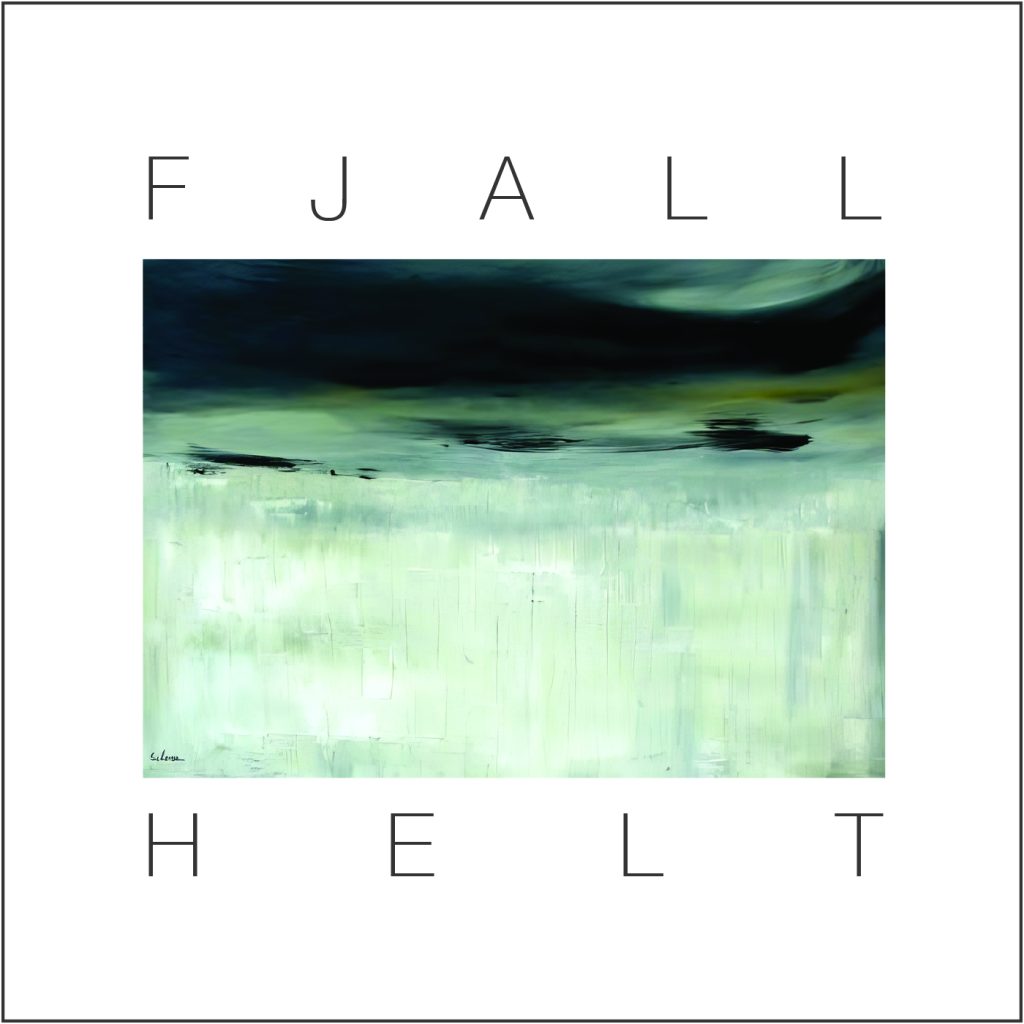
The music mirrors the ambiguity of the beautiful cover painting: is it tundra, a waterscape, entirely abstract, or all those things. A largely meditative character prevails, emphasizing tone and atmosphere over conventional structure or development. Samples and found sounds, such as bird calls, trickling water, and an awakening forest reinforce comparisons to the natural world. Like a river or the ocean, it is always the same, but always changing. Textures surface, bloom and recede, sharpened by acute sensitivity to what might fit best and an instinct for proportion over dramatic contrast, despite intermittent eruptions of noise.
Those qualities emerge differently across each of the four sets, even the shortest of which surpasses 35 minutes. “Stone” embarks on a gradually unfolding arc, beginning reverential and hushed. It builds to a percussion crescendo, curtailed by an organ-like flourish, before one of the first instances of a steady pulse offers a tentative resolution. On “Edge,” tablas and drone evoke an Indian raga feel, amplified by an elusive melody that resembles the traditional Irish folk tune “And She Moved Through The Fair.” Subsequent chanting introduces ritualistic overtones. The quartet mostly avoids moments of abrasion, such that when the drums kick in they suggest a procession, not a fracas.
“Dale” presents a side of the group less evident in the other sets, with more disruptions, melodic and harmonic fragments. It opens on a martial beat accompanying a sustained melodica lament, continuing with further outbursts of metric time and propulsion spicing the drones. Archer’s horns wax more prolific, with a squiggling sopranino saxophone over percussive punctuations supplying one of the most animated passages of the program, while samples of muffled voices later promote unease, dispersing any hint of cozy ambience.
Fjall demonstrates that improvisation need not chase climax to sustain interest: restraint, imagination and a finely tuned collective ear prove more than sufficient. – John Sharpe, ALL ABOUT JAZZ https://www.allaboutjazz.com/helt-fjall-discus-music
Further to my review of Fjall’s debut FROM THE ROUGH HILL, which accompanied the Martin Archer interview in Audion 77, I’d have to say that as a unit Fjall have gone from strength to strength, not only in their creativity, but also in their diversity and the purely wonderful buzz of it all. Fjall have created a unique dialogue, which they continue to develop and expand upon, something that they are equally adept at in a live concert situation as they are in the studio.
Previously I quoted the likes of Between, with AMM Music, Karlheinz Stockhausen, Stomu Yamash’ta and Toru Takemitsu as the most obvious pointers. But, with these live recordings on HELT such elements are less obvious, and I’m as much inclined to mention more obscure improvising ensembles such as Sonde (from Canada) or Gravity Adjusters Expansion Band (see Audion 65). Disc 1, recorded on the 27th April 2025 at a venue named “Sidney & Matilda” in Sheffield, comprises just two sets, of which the opening Stone is largely abstract percussives for the initial 20+ minutes of its 36 minute duration. This is the sort of percussion that’s sans rhythm, being coaxed, rubbed, bowed, all with a slowly building tension, coloured with electronic effects, mutated flute, and other things, eventually breaking out as drum-led crescendo of tribal-esque drums. Of the other textures heard, Jan Todd’s electric Harp-E, psaltery, waterphones and suchlike, all add extra colour, as does Martin Archer’s organ playing on its final phase. After that, Edge opens with what sounds like a tamboura drone, firmly sealing the middle Eastern reference with Fran Comyn playing tabla, and Martin Archer on melodica. So, the ghost of Between returns again, at least for a while, before it takes a turn to genre blend that’s quite unlike anything I’ve heard before, before shifting to a gong and cymbals sustained drone state before going somewhat oriental at the end.
Disc 2, recorded 1½ years earlier on the 7th of December 2023, at Samuel Worth Chapel, Sheffield, is also a document of two sets. The opening Wood is largely a percussion workshop during its first section, sounding like Eddie Prevost (of AMM) working with Sonde as it progresses, which then bridges via a section with sound effects / location recordings, and transforming to what sounds like some weird ritual dirge with drones from a hulusi flute and the addition of clarinet, after which it shifts through a variety of phases, threatening to coalesce with a steady groove – yet it never does. So, it was a surprise when the second set Dale opens with what is almost a dub groove with melodica lead, and certainly the most “conventionally musical” section of it all. In a way, those 5-minutes are like a light interlude before it all gets seriously deep again, and then goes elsewhere – including another section of nature recordings, this time featuring crows! – Alan Freeman, AUDION
Without looking at the press release I had it in my mind that these guys were probably Norwegian, little did I know they were somewhat closer to home and are an English group comprising Martin Archer (Bb and bass clarinets, sopranino saxophone, flute, bagpipe chanter, recorders, organ, melodica, harmonicas, iPad, glockenspiel, tuning forks, small percussion, loops and delays), Jan Todd (electric Harp-E, cross strung harp, bowed psaltery, tagelharpa, hulusi flutes, waterphones, Idiopan, voice, electronics, electronic samples, found sounds, looping, field recordings), Fran Comyn (snare and floor toms, cymbals frame drums, tam tam and small gongs, tabla, doumbek, bells, orchestral chimes, stir drum and shakers) and Richard Jackson (four piece kit, rototoms, cymbals, slot drum, small percussion). Given that cornucopia of instrumentation this is obviously a studio album, isn’t it? Nope, what we have here are two complete performances (one from 2023 and one from 2025), each broken into two pieces, the shortest of the four still being more than 35 minutes long.
Improvised music can take many forms, and it is not unusual for some bands to just plug in and see where they end up, but in this case Fjall has a stated aim of wanting to create soundscapes rooted in folk and ceremonial music. They combine this with field recordings material drawn from the sounds of the natural world and it makes for a very strange mix indeed, which is incredibly visual. There is a small section where we hear waves pounding on a beach, with crows in the distance, and it is intensely visual, with the quartet ensuring the music being created highlights that. It feels far more like a film for the ears, a soundtrack to our imagination being taken on a journey, than it does a group of musicians casting a spell on the audience. That one can hear total silence during the performance is not at all surprising given the intensity, and I can imagine many closed their eyes, so they had no distractions with the music being the only thing that mattered.
Martin runs Discus Music and must be praised for not only releasing some wonderful material but also the care given to the packaging. This double CD release feels sumptuous, with very high-quality printing, and is a joy to open and hold, incredibly tactile in the way album covers used to be. This is one of my favourite releases from the label yet, and if you want music which takes your ears on a journey then look no further. Rating: 9/10 – Kev Rowland, HOUSE OF PROG https://houseofprog.com/fjall-helt-2026/
Each member of the Fjall foursome is an instrument collector, their loaded lorry of gear not being dragged along out of an obsessive hoarder need, but rather to facilitate the creation of a very particular music that gradually moves through its own carefully built environment, using a vast array of blown (sopranino saxophone, clarinets, flutes) and strung instruments (various harps), and featuring two advanced drummer-percussionists, both of them blessed with a mammoth range of skin and metal constructions. Electronics and aural sampling also abound. ‘Fjall’ means ‘mountain’ in Swedish, clearly referring here to the band’s instrument stack.
You were always taught that quality tops quantity, but the very presentation of these two Sheffield gigs is maximalist to the max. Both of the two discs are bulging with their full 80 minutes, and each improvisation lingers for 35 up to 43 minutes. Everything is full-on, excepting that the music itself is terminally relaxed, slow, sparse, detailed and savouring sounds made out of many ethno-instruments, but reborn in the Fjall fashion, shorn of specific folkishness, and side-stepping many of free improvisation’s expected moves. Fjall are closer to The Necks, in terms of a (crawling) linear freeness, a timeline of gradual evolution, and an attention to granular detail.
Martin Archer is a prolific multi-instrumentalist (mainly reeds and organ-type keys), and he also runs the equally productive (and long-running) Discus label, most of whose music springs from jazz and improvisation. All four Fjalls are skilled at self-restraint and introverted expression, these gigs at Sidney & Matilda and the Samuel Worth Chapel involving caverns of meditational existence. ‘Stone’, ‘Edge’, ‘Wood’ and ‘Dale’ mark the improvisations out as ritual shapers, as the audiences slip inside their gentle grip of magic. – Martin Longley, JAZZWISE
Tracks 1 and 2 (2025 recordings)Stone and Edge are two pieces that give free rein to a fantastical, cinematic cultural universe, overflowing with instrumental sonorities and, in the second half of track 2, a few voices and songs. These are unfolding frescoes of infinite horizons, undefined in the way each movement is shaped in relation to the breath or surface of the instruments. Natural outdoor sounds are heard at the same time as the instruments imitate bird calls, wave surges, foghorns, mingling with celestial small percussion, clarinet, tam-tam, tuning fork, striking drum rolls, bouncing snare drum, drone strings, bagpipe… In all the places evoked, the bold traits of the soloists stand out, with brass, harps, electronic effects, tabla, organ, cymbals, bells, orchestral chimes. Noble tones emerge from rare instruments such as the sopranino saxophone, hulusi flutes, cross-strung harp, bowed psaltery, tagelharpa, B-flat and bass clarinets, bass toms, horns, harmonica filled with beauty. Magical water sounds flow delicately, their impact awakening an intangible thread of nostalgia, especially with the organ and dreamlike bells as if carried by elves.Indian-inflected sonorities drift in duo with the harmonica, which complacently repeats its phrases undisturbed. Different domains of sound pass by like cathedrals shaped from wind, sand, dreams. Magical illusions, muffled sonorities evaporate as percussive techniques evolve, and the reception of this music becomes a revelation within the enigmatic immersion of sonic wonders. A double belonging to mystery and myth, as on tracks 3 and 4 of the second CD.
Tracks 3 and 4 (2023 recordings)Wood and Dale — the ensemble gives body to fantasy through its presence, giving form to the void, nourishing it with sounds, noises, percussion, bells, brass, wind, wood. Thus the music continues its path accompanied by thousands of incredible sonorities, inscribed in the adventurous, experimental, avant-garde, electronic, progressive, fantastical lineage. Long, strange stretches of disparate sonorities, without melody, spread through space simply because they reveal another language. The musicians immerse themselves in this music, creating a representation of multicoloured images sent back by the ear from the sounds of another world. Their musical universe reveals itself as supple, limpid, free, yet also opaque or shadowy, among transparent chants, distinct bird whistles, and diverse sounds of living things. Fan-shaped, firmly rhythmic percussion, bagpipe, brass, harp, bells embed themselves in the twists of contorted, strangely audacious sopranino sonorities, composing, decomposing, repeating and beginning again endlessly, in all its versions and contours. A distinguished sitar sings, embellishing the panorama shaped like an ascending hill, dependent on electronic stimuli, crystalline water sounds slipping through the instruments like life itself. Sonic constructions circulate and mutate in an impressive opening of this universe of sounds and instruments offered to our perception. They unfold infinitely, escorted by suitcases of percussion, fortresses of wind, brass, wood, agitated cymbals, electronics. Multiplications of vague sonorities articulate and disarticulate incessantly across different levels of structure, under various ghostly jazz-like forms.
Conclusion HELT, across two discs, triumphs live through an unprecedented succession and continuity of striking sonorities. These vast sonic perspectives create infinite avant-garde legendary pathways, carrying us on the spine of their percussion through mysterious aerial corridors. Their music pierces silence, amplifying their experimental, inspired, incomparable imaginative artistry. Their way of playing adds a musically extravagant advantage. A rare ensemble, remarkable both for its musical improvisation and its elegance of style, familiarising us with the natural sounds of the Earth and those generated by four virtuosos.(****¼) — Marie Mesmer, HIGHLANDS
You can buy your CD or DL either direct from Discus Music or from Bandcamp. The prices and the postage charges are the same on both sites, but Bandcamp will charge you VAT on DL only purchases. Whichever site you choose, the DL element is delivered to your Bandcamp collection.
Discus pays a 10% commission to Bandcamp on sales there, but if you buy direct from Discus Music we get to keep 100% – which of course we prefer! But in the end, please buy from whichever site suits you best.
